Transformative Play
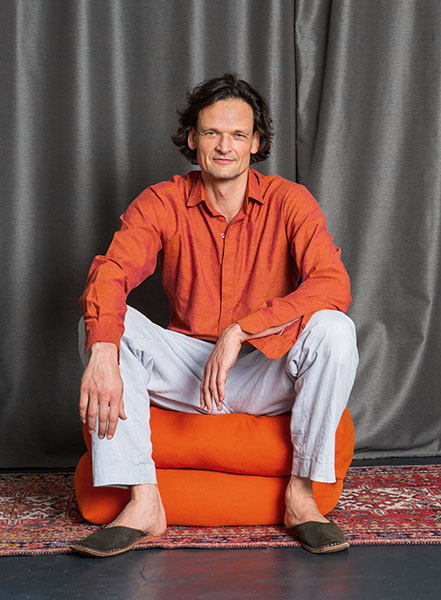
We mistake how we act for who we are.
As children, we knew how to do this. We stepped into roles without hesitation, built shared worlds out of nothing, and believed in them completely. Somewhere along the way, most of us stopped. We started to think: this is just who I am. We mistake how we act for who we are.
My work is about rediscovering that capacity — in adults, in groups, through guided roleplay as an art form. Something happens when people play together seriously. The room changes. People surprise themselves. Participants in Language of Plants have described channeling a plant spirit without meaning to. Others have found themselves moved in ways they didn't see coming. The scenarios range further than you might expect: participants embody plants, money or organs.
There's no audience. Everyone in the room is inside the experience, guided but playing. What gets made isn't an object or a performance. The work happens inside each participant, and only exists while it's happening.
I design the structure — the scenario, the roles, the arc from beginning to end — and guide it throughout. You don't need a script, a costume, or acting experience. What you need is willingness, and a group to play with.
The weekly Roleplay Lab is where most people start — open, 90 minutes, donation-based. The longer scenarios go further and tend to leave people with things they won't quite find words for yet.
The Practice
Roman Schramm
Roman Schramm is a Berlin-based artist working at the intersection of participatory art, roleplay design, and social sculpture. His practice focuses on creating experiences that produce states of being participants didn't have words for beforehand.
Selected presentations: Museum Sinclair Haus (Bad Homburg), Badischer Kunstverein (Karlsruhe), KW Institute for Contemporary Art (Berlin), Neuer Berliner Kunstverein (Berlin), Kunsthaus Dresden, Knutepunkt (Oslo), Stockholm Scenario Festival, Blackbox (Copenhagen).
He runs a weekly Roleplay Lab in Berlin-Neukölln and is available for commissions, collaborations, and institutional partnerships. For his visual art practice, visit: romanschramm.de
Upcoming Events
Registration required for all sessions — spots are limited.
2026
2026
2026
2026
2026
2026
2026
2026
2026
2026
2026
2026
Scenarios
A weekly space to play — seriously and without an agenda. We borrow from psychodrama, Gestalt, LARP, and theatre, not to perform for others, but to find out what happens when you stop being quite so yourself for 90 minutes.
Each session is different. Sometimes one long scenario, sometimes several short ones. Always guided, always with time to land afterwards.
No experience needed. Every session starts fresh — you can drop in for the first time any Thursday.
Donation-based · Suggested contribution 10–20€
Studio Schramm Berlin
Schönstedtstr. 13, Berlin-Neukölln
Look for the big red front door: Ring Schramm. Walk through to the first courtyard: Ring Schramm again. Entrance on the left in the second courtyard, by the elevator. Third floor, door on the right.
Please sign up via the link below and arrive 5–10 minutes early.
What happens when you try to have a conversation with something that operates on a completely different timescale, has no voice, and doesn't need you at all?
In this roleplay, participants alternate between being human and being one of four plants: Nettle, Oak, Yarrow, and Mugwort. The plants aren't symbols or metaphors. They're presences with their own logic, their own demands, their own silence.
What people take from the experience varies. Some describe it as finally understanding what it means to listen without being able to respond. Others report something stranger — a sense of channeling the plant rather than playing it. The format doesn't predict which it will be. It creates the conditions and steps back.
The experience moves through four structured encounters between humans and plants, framed by an opening warm-up and a closing reflection round.
AI is everywhere: in the news, in our hopes, in our fears. Yet it stays abstract. This scenario makes it tangible by asking participants to alternate between playing a human and an AI.
One person steps into a state where biographical weight falls away, along with the constant need to cushion words. Because humans have bodies, complete non-embodiment is impossible. In that struggle, habitual patterns show up in a clear light.
At the same time, the AI role carries pre-programmed constraints, safety guardrails, and corporate filter systems. Embodying it exposes two layers at once: human conditioning and the invisible boundaries of the machine.
Without a human counterpart on the other side, intimacy dissolves into something stranger. Polite small talk dies instantly. The conversation becomes uncanny, unpredictable, and slightly unnatural.
The roleplay uses this uncanny quality as material. It is not a technology demonstration. It is an investigation into how we feel and move when the familiar rules of conversation fall away.
You know the feeling. The rejections, the applications, the money, the endless navigation of structures that weren't built for you. It accumulates, and somewhere in all of it the thing you actually came here for gets quieter.
This is a space where a small group of artists brings all of that into a room together. Through guided exercises, we work with the frustration directly — using it as raw material, until it turns back into flow.
People leave with a clearer head and a different perspective on their work.
Every couple fights. But what if someone dictated how you fight — and it always went slightly wrong?
You and a partner play a fictional couple, from the first date, through falling in love, all the way to a holiday in Italy. The early scenes are easy: the getting-to-know-each-other, the excitement, the moment something clicks. Then you arrive at the Airbnb. The Airbnb is shit. And it's someone's fault. Your first fight.
When conflict arises, you draw a Conflict Card. It tells you how to fight: avoidant silence, dramatic accusations, passive-aggressive kindness, rational detachment. You follow the card. The other person doesn't know what you drew.
What follows is awkward, funny, and oddly revealing (in that order, or not in that order).
You stand in front of a real artwork. One of you is the artist. The other is a visitor, but which kind? A wealthy collector ready to buy, a critical curator, a child with an uncomfortable question. The artist doesn't know yet. The visitor draws a card. A random element dictates their aesthetic bias. Then the conversation begins.
The artist also rolls. Maybe they love this work. Maybe they don't anymore. They don't say. Neither does the visitor (not directly).
The game strips away gallery etiquette to reveal the power dynamics underneath: the desperate signaling, the silent fear of being found out, the weight of a question depending on who's asking it. What does a child ask that a curator never would?
By the end, everyone in the room looks at the artworks differently. That shift is the point.
When was the last time you lied to your money?
In this roleplay, that question becomes literal. Participants work in pairs: one plays the Human, the other becomes Money itself. And like any long-term relationship, this one has history. Unspoken resentments. Misplaced trust. Moments where one of them wasn't there when it mattered.
"I don't trust you," says the Human.
"You're so jealous," says Money. "When did I ever let you down?"
At some point, the two of them end up in couples therapy. They lie to each other. They fight. They might reconcile.
Most of us have been in this relationship our whole lives without ever looking at it directly. Here, it sits across from you and talks back.
You already know how to do this. You just forgot.
Before language became the primary tool, before self-consciousness set in, you understood the world by playing in it. A lost toy was a genuine tragedy. A new friend was everything. Fairness was an absolute law. The stakes were always high — and you were always completely present.
This scenario invites adult participants back into that state. Not by acting childish, but by physically and somatically shifting into a different way of inhabiting the world.
We trade the head for the floor.
In the fictional kindergarten we build together, emotions aren't managed. They move through the room. The experience is guided throughout — you won't be left alone in it.
The moment the test turns positive, reality shifts. Not just for one person. For everyone in the room.
This scenario explores pregnancy and early parenthood from the inside, through the eyes of everyone involved. You might play the carrier, navigating a physical self that is no longer quite your own. Or the partner, suddenly responsible in ways nobody prepared you for. Or a family member trying to find their place in a constellation that's rearranging itself around a life that doesn't exist yet. Someone also plays the becoming — the unborn presence, not yet a person, but already reshaping everything around it.
The scenario traces the thresholds: the first conversation after the test, the weight of a decision, ambivalence, fear, sometimes loss, the intensity of labor, the first days after. Nothing is biologically realistic. Everything is emotionally true.
Like every scenario here, it runs inside a clear structure of consent, onboarding, and a guided way back out.
What does "Never again" mean in your body, right now?
This project explores the echo of history in posture, in silence, in the friction between people from different cultural and geographical backgrounds who find themselves in the same room. It's a physical experience, not a political debate.
Participants built characters, shifted perspectives through role reversals, and shaped collective non-verbal narratives under pressure, guided but without scripts.
The work was created with musician Lucie Páchová, who designed sound improvisation exercises for each round. Movement was central throughout: participants inhabited their roles through walking, standing, sitting, lying, in relation to each other, without words. The sound gave the movement a language. What held it all together was a strictly non-judgmental sharing practice: after each round, participants spoke without comment or response. Just witness.
The premise is simple: you're on a holiday island. Who are you there?
Participants build characters together, find their connections, and then play — without further instruction. What emerges is a small society, invented from scratch, with its own dynamics, alliances, and tensions. Nobody planned it. It just grew.
At the end, the island dissolves and people step out of their roles. In the sharing round that follows, what usually surfaces is surprise — at who they became, and at what can happen between people who were complete strangers an hour before.
This format goes back to the origin of roleplay, which predates theater by millennia. No stage, no audience, no script. Just the immediate experience.
In Development
Studio Schramm
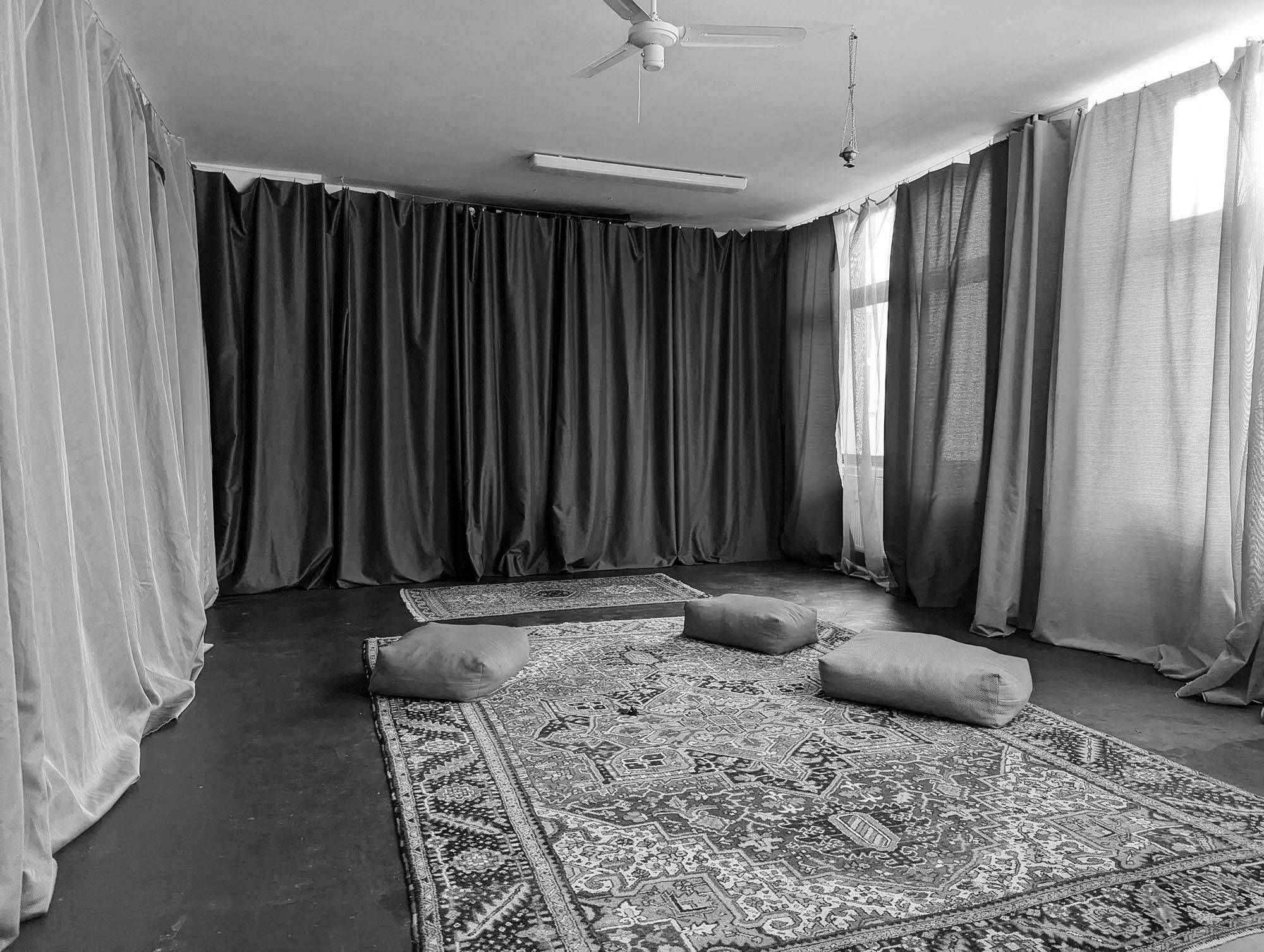
A carpeted room with large cushions and curtains, in the middle of Neukölln. The Lab happens on the floor here — close to the ground, close to each other. It's a working artist's studio, and it feels like one: warm, particular, a little apart from the city outside.
Connect
Newsletter
Occasional. For people who want to stay in the loop without being in it constantly.
Sign upContact
To sign up for a session or ask a question, write to:
Past Events
2026
2026
2026
2026
2026
2026
2026
2026
2026
2025
2025
2025
2025
2025
2025
2025
2025
2025
2025
2025
2025
2025