For Organizers
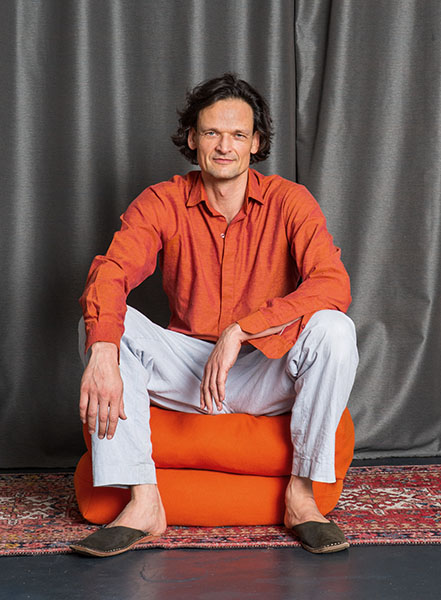
Some topics only open up once you stand inside them.
I'm a visual artist, and my medium is the guided roleplay. A group steps into a topic together and plays it: a plant, a machine, an organ inside one's own body. The room changes. People surprise themselves, and the conversation afterwards starts from something they lived.
There is no audience. Everyone in the room plays, guided, with a clear structure and a safety design from the Nordic larp tradition. No acting experience needed.
Selected presentations: Museum Sinclair Haus (Bad Homburg), Badischer Kunstverein (Karlsruhe), KW Institute for Contemporary Art (Berlin), Neuer Berliner Kunstverein (Berlin), Kunsthaus Dresden, Knutepunkt (Oslo), Stockholm Scenario Festival, Blackbox (Copenhagen), summer meeting of young midwives (Deutzen).
Museums
A contribution to your exhibition, or a program alongside it. I develop a scenario from the themes of the show, so visitors step into the topic instead of looking at it from outside. It can stand inside the exhibition as a work in its own right or run as a public program. Both start with a conversation about your exhibition.
Language of Plants. Participants alternate between being human and being one of four medicinal plants: nettle, oak, yarrow, mugwort. With Omi-peah Ryding. Commissioned by Museum Sinclair Haus; played in Oslo, Stockholm, Copenhagen, Karlsruhe and Berlin.
“… they weren't portraying a plant so much as channeling a plant spirit.”Lizzie Stark, author and participation designer, participant in Language of Plants
Is This Your Artwork? Participants stand in front of a real artwork. One plays the artist, the other a visitor. Cards decide what kind of visitor, and how the artist feels about the work. Afterwards the group talks about what they saw in the work while playing.
Universities
I develop a scenario with your students around a question from their field, for example in medicine, design, ethics, sociology or art. The students help write it, then play it. Tell me the course, the semester and the question, and I will suggest a format. For art schools, a creativity lab is in development.
Medicine & Care
Practising situations from the inside, for medical and nursing education, midwifery, hospitals, medical ethics and patient organisations. Scenarios can also be developed with your team or students.
I'm Pregnant. The roles around one life-changing moment: expectant parent, partner, family, and the baby, passive but present. First developed at playlets, presented at the summer meeting of young midwives in Deutzen.
The Guest in Me. In development: organ transplantation as an encounter with the foreign inside one's own body. Donor, organs and recipients are each played by a person. With author David Wagner, grounded in transplant psychology.
Conferences & Organizations
Two ways to bring this into a program.
Embodying AI, full session. Participants alternate between playing a human and an AI. The work exposes both our habitual patterns and the machine's invisible guardrails. Works as a conference session or as an internal session for organizations introducing AI. Created with Blasius Walch.
“The line that stuck with me: ‘I cannot understand you. I can model understanding, but I cannot understand you.’”Ben, participant in Embodying AI
Embedded in the program. A group within the conference plays while the program goes on. Others hear about it at lunch and in the corridors. An artist builds something into the program.
Something else
Schools, planning agencies, neighbourhood projects, teams. If a topic needs to be felt before it can be discussed, write to me.
How it works
Onboarding. Warm-ups, movement and clear agreements bring the group into the room and build trust, consent and the shared fiction.
Play. Participants enter their roles. The scenario unfolds, guided but not scripted. I hold the frame throughout.
De-roling and debrief. A structured way out of the role, then reflection rounds that connect the experience to your topic.
Safety is part of the design. Everyone knows in advance what will happen, and topics can be excluded or only hinted at (“lines and veils”). Anyone can lower the intensity, pause or step out at any time, without explanation. The format builds on the Nordic larp tradition, which has a craft for playing difficult material together, and I'm trained in Mental Health First Aid. This is an art practice, not therapy.
Conditions
Fees depend on format, length and travel. After a first conversation I send a proposal. Reduced rates are possible for non-profit and grassroots organisations. Sessions in English or German. Want to try it first? Join a Roleplay Lab in Berlin.
Get in touch
Write a few lines and I'll reply within two working days. It helps to know your event or institution and the date or time window, who will take part and roughly how many, and the topic or question you want people to experience.